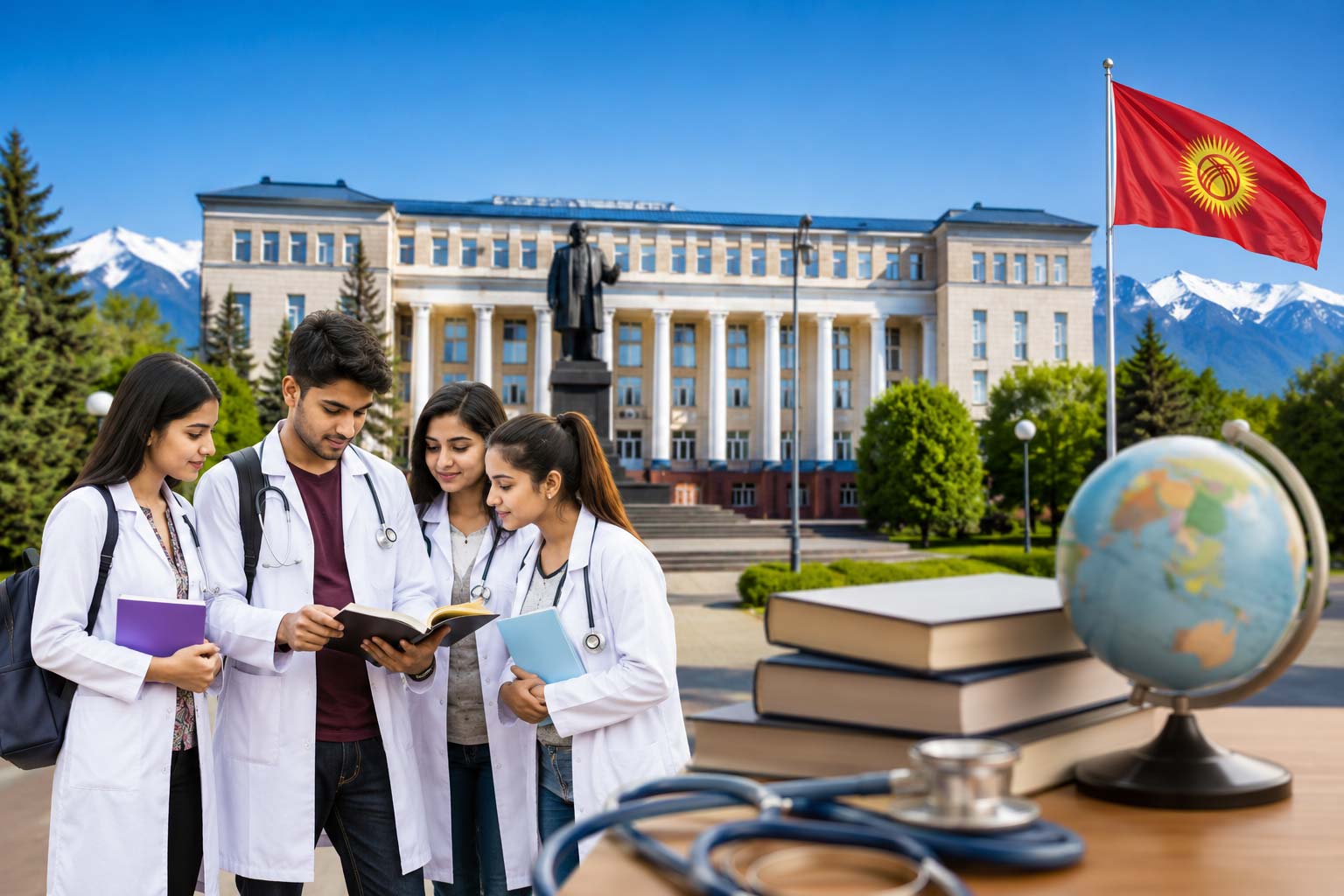
When Kyrgyzstan’s Ministry of Health released the results of its 2026 state accreditation review of medical universities, thirteen institutions failed outright and only four received the maximum accreditation term. Kyrgyz Russian Slavic University was not even part of that review — and the reason says a lot about how the university is structured.
A university built on a treaty
Kyrgyz Russian Slavic University, commonly known as KRSU, was established in Bishkek in 1993 under an intergovernmental agreement between Russia and Kyrgyzstan. Because it operates under this treaty rather than a standard private education licence, KRSU — along with the Kyrgyz State Medical Academy and Kyrgyz-Turkish Manas University — was legally exempt from the May 2026 accreditation review that affected the country’s other medical institutions. The thirteen universities that failed the review were all privately run.
Recognition that can be independently verified
KRSU is listed in the WHO’s World Directory of Medical Schools and is approved by India’s National Medical Commission (NMC), meaning its MBBS graduates are eligible to sit for the Foreign Medical Graduate Examination (FMGE) in India. The university also holds accreditation from FAIMER, ECFMG and Russia’s Ministry of Education. In the 2024 FMGE results, KRSU recorded a 39.66% pass rate — the highest among all Kyrgyzstan universities that year, and well above the national average for Kyrgyz medical graduates.
Programme structure
The MBBS programme in Kyrgyzstan at KRSU runs for six years — five years of academic study followed by a one-year clinical internship — and is taught in English, with Russian language classes included to prepare students for clinical rotations. The university has kept its intake for international students deliberately limited: seats have grown gradually from just 15 when the English-medium programme launched in 2015 to around 125 for the 2026 intake, a pace the university has tied to expanding its faculty and clinical facilities.
Eligibility and cost
Indian applicants need a Class 12 certificate with at least 50% marks in Physics, Chemistry and Biology (40% for reserved categories), a valid NEET score, and must be 17 years or older by 31 December of the admission year. Tuition is quoted at roughly $3,300 to $3,500 a year by most independent sources, though total costs — including hostel, food and administered services — run higher, so applicants should ask for a complete, itemised fee breakdown before paying anything.
Campus and city
KRSU is based in Bishkek, the Kyrgyz capital, and includes seven institutes and thirteen faculties, with its Faculty of Medicine organised into around 30 specialised departments. Its postgraduate medical offerings extend to more than two dozen clinical specialisations. Bishkek itself is generally considered safe for international students, with an established Indian community and access to Indian food near most student hostels.
Why the exemption matters for applicants
For a prospective student, KRSU’s treaty-based status is not just an interesting technicality — it means the university’s accreditation does not depend on passing the same review that thirteen other institutions failed in 2026. Combined with its NMC and WHO recognition and its relatively strong FMGE track record, this makes KRSU one of the more thoroughly documented options for Indian students currently considering Kyrgyzstan, though students should still independently confirm current fee and seat numbers directly with the university before applying.